iGaming Event Staffing and Expo Planning: Yuliya Sehen Interview
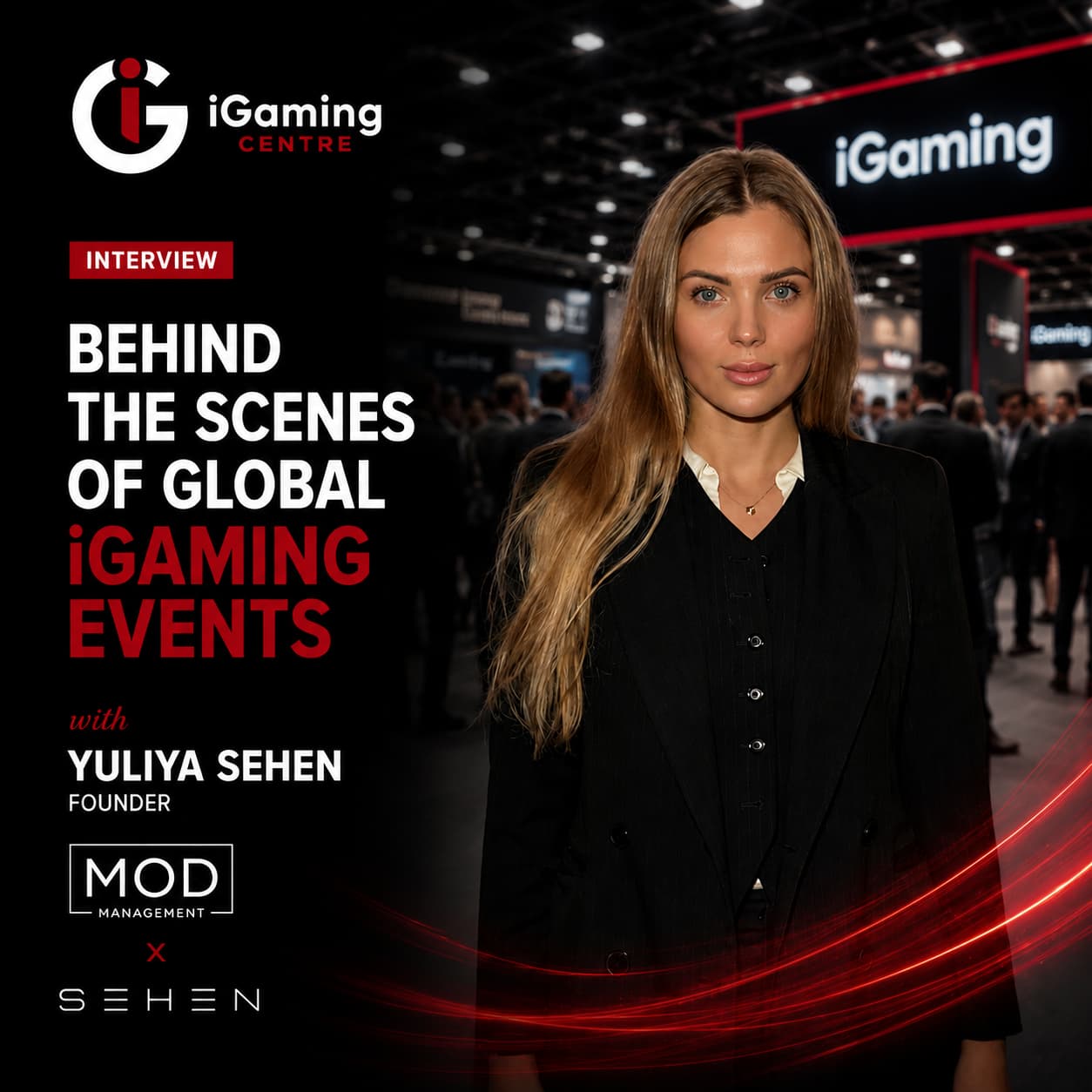
Planning an iGaming exhibition means coordinating people as carefully as the stand itself. In this interview, Yuliya Sehen of MOD MGT Events discusses the staffing and operational decisions behind an effective event presence.
The conversation covers staff selection, communication, last-minute disruptions and the relationship between exhibition goals and visitor experience. It also explores her work as a DJ at industry events.
Interview by iGaming Centre. Questions are grouped by topic; Yuliya’s answers retain their original wording. Editorial notes and the closing checklist are additions by iGaming Centre.
In this interview
- Yuliya Sehen and MOD MGT Events
- Choosing and briefing an iGaming exhibition team
- Managing staffing problems during an exhibition
- What makes an iGaming event successful?
- Industry events, afterparties and Yuliya’s DJ career
Yuliya Sehen and MOD MGT Events
Can you tell us more about what you do, how long you’ve been doing it, and how this business started? What was your first iGaming event?
A: I work in two main areas: a staffing agency and an event agency. But we don’t just provide staff — we specialize in selecting VIP hostesses and handling more complex, non-standard client requests.
At the same time, we are not limited to staffing alone. We also create turnkey events, from concept to full execution. This includes private events, afterparties, networking events, stand activations, bar areas, specialty coffee services, entertainment, photographers, videographers, performers, and everything else that helps a brand stand out.
I have been in the exhibition industry for about nine years. Everything developed step by step. I started by working at exhibitions myself, then became a supervisor, later an organizer, and eventually it naturally grew into my own agency.
My first iGaming event was in Lisbon. That was the moment when I truly started to understand how dynamic, fast-paced, and exciting this industry is.
How many expos do you attend per year? Is it like living out of a suitcase?
A: We have never really counted how many expos we do per year.
But if I look at my personal schedule, I have flights every one to two weeks, and sometimes even every seven days.
There are smaller exhibitions where we work with one or two clients, and there are large exhibitions where we manage 50 to even 60 clients at the same time. So the scale is constantly changing.
We don’t work only in iGaming. We also work in technology, blockchain, automotive, fashion, pharma, beauty, and many other industries.
In reality, there are exhibitions for almost everything. Every industry has its own events, and all of them require staff, coordination, and organisation.
In addition to exhibitions, we also have an events division. We organise private events, corporate events, networking events, afterparties, and full turnkey projects for clients worldwide.
Yes, in many ways it is a lifestyle of constant travel. But for me, this has always been part of the dream — to work, travel, and be part of an international industry at the same time.
Choosing and briefing an iGaming exhibition team
What is one thing people from outside the industry underestimate about making an expo presence successful?
A: People often underestimate that a successful expo presence is a system.
It is not enough to just book a stand, put up a nice design, hire hostesses, and give away merch. You need to clearly understand your goal — whether it is brand awareness, social media growth, lead generation, networking, or partnerships.
Many companies waste budget on merch that no one actually needs. Pens, notebooks, basic caps, or simple branded T-shirts are not always what people want to receive at an iGaming expo.
It is much better to create fewer items but make them high-quality and desirable. Gadgets work very well — chargers, adapters, cables, AirTags, travel pillows, earplugs, good-quality portable speakers. Anything related to travel is especially relevant, because people in this industry travel a lot.
Clothing like T-shirts, hoodies, or socks can also work, but only if they have a strong, stylish design. If it is just a logo, people are not interested. No one wants to feel like walking advertising.
Another thing companies underestimate is staff selection. Many clients choose hostesses based only on photos or videos from a catalogue. But I often recommend trusting the agency with selection, because I know my team. I know how each person communicates, how they perform under pressure, and how they fit different brands.
This is a more personal and strategic approach. Sometimes a client chooses based on appearance, but I know that another person may be a better fit for the brand in terms of communication and energy.
It is also important to understand that there are different types of staff — promo staff, classic hostesses, models, grid girls, male hostesses. These are all different roles. A model-type presence can work well for visual attraction, but for communication and lead generation, personality and confidence matter much more.
Many brands also underestimate male hostesses. The iGaming industry is no longer exclusively male, and a balanced team can create a more dynamic presence.
Another important detail is staff comfort — food, water, proper breaks, and comfortable uniforms and shoes. It may seem like a small thing, but it directly affects mood and performance.
Hostesses are not decoration. They are the first point of contact between the brand and the visitor. If they are not properly briefed, if they don’t understand the product, or if they feel uncomfortable, the stand loses opportunities.
In B2B — especially in iGaming — everything is built on communication. And very often, the hostess is the one who starts that communication.
What makes an iGaming exhibition stand successful?
A: For me, the key factor is the staff.
A hostess is the face of the company — the first point of contact and the person who creates the first impression.
The company’s attitude toward staff is very important. If there is respect and proper communication, the results are completely different.
The team itself is also crucial. A strong stand is not only about design or activities, but also about the atmosphere within the team.
Visitors feel this immediately.
We also create uniforms. I personally work on the design to ensure it looks professional and is comfortable.
Comfort directly affects performance. It is impossible to expect someone to work 8–10 hours in uncomfortable shoes.
Activities, coffee, interaction, and good merch also play a big role.
What are the biggest communication challenges with hostesses?
A: One of the main issues is phone usage.
People are very dependent on their phones, and this can affect work. We monitor this on site.
Another challenge is communication and understanding roles. Sometimes instructions need to be repeated, and sometimes people try to take on too much.
Clear structure and communication are essential.
What are the funniest or most unusual requests?
A: Very often, clients want everything in one person.
A beautiful girl who speaks several languages, can sell, communicate, entertain guests, make coffee, run activities, and never gets tired.
Of course, such people exist, but they are rare.
There are also unusual requests related to specific appearances or roles. This is normal in the event industry, but it requires careful communication.
The most challenging requests are when expectations do not match reality.
Managing staffing problems during an exhibition
What are the most challenging aspects of this business?
A: The most difficult part is the human factor. Always.
When you work with people, you cannot control everything one hundred percent. Someone can get sick, be late, misunderstand a task, feel insecure, or simply not match the brand in terms of energy and communication.
It becomes even more complicated when you work internationally. Every country has a different mentality and a different understanding of responsibility, time, and communication. In some places, people are more independent; in others, you need to explain everything step by step. Language barriers also play a role.
This also means working with girls, models, and hostesses, and in this kind of work it is important not only to demand results, but also to communicate correctly. You need to be strict but fair. You need to maintain control without putting pressure on people. You need to explain, support, and at the same time maintain discipline.
This is not a business where you can simply place staff and relax. You always need to stay involved, understand what is happening, anticipate problems, and react quickly.
You work with expos around the world. What are the biggest cultural differences you notice?
A: This is one of my favorite topics, because cultural differences have a huge impact on the way people work.
If I had to highlight specific regions, I would immediately mention Latin America, especially Brazil, and to some extent Portugal. There is a very relaxed approach, which is often expressed with the phrase “tranquilo, tudo bem”. On the surface, everything sounds fine, everything is calm, and everything seems to be under control. But in reality, that does not always mean things are actually getting done.
In these regions, it is very important to give clear and structured instructions. You cannot simply say, “do it nicely” or “you know what to do.” You need to explain everything step by step: what exactly needs to be done, when, where, by whom, and in what format.
You cannot assume things will be understood automatically or that people will take initiative in the way you expect. It is not good or bad — it is simply a different working culture. And if you understand that in advance, you can build the process much more effectively.
Cultural differences affect everything: punctuality, communication style, attitudes toward deadlines, and reactions to stress. That is why working internationally requires flexibility and the ability to adapt.
How do you handle exhibition staff absences and last-minute problems?
A: I try to personally be present at the biggest exhibitions, especially when we have a large number of staff or more complex setups.
Nowadays, if someone doesn’t show up, it is usually for a serious reason. The most common issues are delays caused by traffic or transport strikes, which sometimes happen right during exhibition days.
People often underestimate how much a city changes during a major event. On a normal day, a journey might take 20 minutes, but during an expo it can easily take an hour or more.
What do we do if staff don't show up? I prefer not to fully reveal our internal processes, because that is part of our agency’s know-how. But the most important thing is that the process never stops. We react quickly, find a replacement, and keep everything running smoothly.
Sometimes a replacement can already be at the stand within 10–20 minutes. For the client, the most important thing is that the stand continues operating without disruption.
How do you deal with fatigue on day two or three?
A: We always joke within the team that we don’t know what fatigue is.
Of course, it exists, but during the event you are so involved that you only really feel it after everything is over.
The week before the event, you are already thinking, “I wish it were over.” The day before is chaos: replacements, cancellations, last-minute requests, uniforms, logistics, briefings.
Day one is the most intense. Day two is about correcting mistakes and managing the team. By day three, things become calmer, and at some point you even feel a little sad that everything is coming to an end.
And the day after, you already miss it.
For me, it is more mental fatigue than physical. You are constantly juggling multiple processes, people, and responsibilities in your head.
Can you remember a moment when something went wrong at an event, but you managed to handle it?
A: The most difficult moments were probably during COVID.
It was a period where, even with perfect preparation, everything could change at the last moment — QR codes, documents, vaccination rules, travel restrictions.
There were situations where staff could not enter an event because their QR codes were not accepted. There were also cases where flights were booked, apartments were rented, everything was ready, but the person still could not board the plane or travel due to sudden rule changes.
These were not typical event problems that you can solve on the spot. They were situations completely outside your control.
In such moments, the only thing you can do is react quickly, find alternatives, communicate honestly with the client, and stay calm.
Regular events always come with small operational issues, but COVID was on a completely different level. It taught us to be much more flexible, prepared, and calm under pressure.
What makes an iGaming event successful?
What are the most memorable events? What sets a good event apart from a mediocre one?
A: Honestly, I remember almost all the events we have worked on. Each new project is always built on the experience of the previous one.
If we talk outside of iGaming, I really enjoy yacht shows. They are a completely different type of event, but interestingly, you still meet people from the iGaming industry there, just in different roles.
A good event is not only about the location, music, or visuals. For me, a good event is when everything looks effortless for both the guests and the client, even though behind the scenes there is a huge amount of work happening.
The difference between a good and a mediocre event lies in the details and in how quickly you react. Something will always go wrong — the question is whether you are prepared for it.
I believe a professional organizer should always see the bigger picture, anticipate risks, and keep everything under control.
How has the iGaming event scene changed over the years, and what do companies need to do differently today to stand out?
A: The iGaming event scene has changed a lot.
When I started, everything was simpler and more relaxed. Stands were less complex, clients were calmer, and the overall atmosphere felt more like a community.
Especially when SiGMA was in Malta, it felt like one big iGaming family. There were parties everywhere, people moved from one event to another, and there was a lot of networking and energy.
Of course, there were also downsides, like transport, limited accommodation, and logistics, but the atmosphere was very strong.
Now everything has become much more competitive. It is a battle of stands, scale, production, visual impact, and experience.
Events have also become more exclusive. Many parties are now closed or have limited access. On one hand, this creates a sense of status. On the other hand, people still want scale, energy, and real networking.
It is also very interesting to see how companies and people have evolved over the years. Many brands have become much bigger and stronger, with better marketing, positioning, and collaborations.
In my opinion, the most important thing today is clarity. Companies need to understand why they are attending an event — not just because everyone else is there, but what exactly they want to achieve.
It is not always the biggest stand that stands out. It is the one where everything is thought through — the team, atmosphere, communication, activities, merch, and follow-up. Today, it is not enough just to be present at an exhibition. You need to create an experience that people will remember.
Industry events, afterparties and Yuliya’s DJ career
Which are your favorite events, if you can name them?
A: If we talk about iGaming, I would definitely say SiGMA. I like that these events take place in different countries, because for me it has always been a dream to work and travel at the same time.
SiGMA also has closing parties where I can perform as a DJ, which makes the connection even more special for me.
After SiGMA, I would mention iGB, especially now that it takes place in Barcelona, where I live. It used to be in London, but now it is in Barcelona, which is great both personally and professionally.
SBC is also a very strong organization. We haven’t worked with them extensively yet, but I would really like to develop this direction and collaborate with them more, including possibly performing as a DJ at their events or closing parties.
Outside of iGaming, I really enjoy Formula 1 events and yacht shows. We work on these almost every year, depending on our schedule, because many major events overlap, and sometimes we need to prioritise based on workload and staffing.
Another important event for us is Bridal Week. It is a very detailed and demanding type of work, especially with models and fashion presentations. It requires a high level of organisation and precision. It also reflects our positioning as a model-hostess and VIP-hostess agency, since many of our hostesses come from a modelling background.
Editor’s note: The London-to-Barcelona move refers to iGB Affiliate, which relocated in 2025. iGB L!VE moved from Amsterdam to London. See the official announcement about the iGB event moves and our iGB Affiliate Barcelona listing for upcoming event details.
Related organiser profiles: Explore SiGMA World and SBC on iGaming Centre.
How did you start your DJ career, and how did you integrate it into iGaming events?
A: I started my DJ journey quite early, around the age of 15 or 16. It wasn’t just a hobby — I was learning from a DJ in my city and preparing for a local DJ competition. I took part in that competition and finished in fourth place, which, for me, was a strong start and gave me the motivation to continue.
A few years later, I moved to China, and that’s where my DJ career really became professional. I became a resident DJ, played in different cities, and performed at clubs, private events, open-air events, and festivals. It was a very intense period that gave me real experience and a deep understanding of how to work with different audiences.
At the same time, I was also working as a model. Because of my height and appearance, I was often booked for catalogues, advertising, and fashion projects, so I was combining DJing and modeling.
When I moved to Europe, I stepped away from DJing for a while and focused more on modeling. Through that environment, I was introduced to hostess work. At that point, I didn’t really know the industry, but I started learning, understanding how exhibitions work, and gradually built my path from hostess to supervisor, then to organizer, and eventually to my own agency.
Music, however, never left my life. I always knew I wanted to come back to it, but in a more structured and professional way. I invested in equipment and returned to DJing with a clearer vision of what I wanted to do.
The integration into iGaming happened very naturally, because I was already deeply involved in the industry through my agency. At some point, I approached SiGMA Group with the idea of performing, and I’m truly grateful they gave me that opportunity. They believed in me, and for me it was a very important step — it opened the door into iGaming as a DJ.
After that first performance, more opportunities started to come — both within iGaming events and private industry parties. People saw me not only as an organizer, but also as an artist, and this combination started to grow naturally.
Now I regularly perform at afterparties and events that we organize for clients, and I continue developing as a DJ within the iGaming space. For me, this is a very organic connection — I understand events from the inside, and at the same time, I can be part of the atmosphere as a DJ.
I definitely want to keep growing in this direction, play at more iGaming events and larger stages, and stay connected to the industry that has already become a big part of my life.
Editor’s checklist for planning an exhibition team
This checklist draws together the interview’s practical themes, with an editorial follow-up step. It is not an additional answer from Yuliya.
- Define the objective. Agree whether the stand is intended to generate leads, build partnerships, raise brand awareness or support another measurable goal.
- Specify each role. Distinguish welcome and hospitality duties from product conversations, lead capture, interpretation and entertainment. Select people for the communication skills the role needs.
- Prepare the briefing. Explain the product, audience, key messages, schedule and the person staff should approach when a visitor needs specialist help.
- Assign an on-site coordinator. Give the team one clear contact for instructions, questions and last-minute changes.
- Plan cover and breaks. Account for transport delays, absence cover, food, water and comfortable uniforms and footwear.
- Arrange follow-up. Decide who will handle the contacts and conversations generated at the event, and review what worked with the team afterwards.
About MOD MGT Events
MOD MGT provides event staffing, talent coordination and event support. For current services and contact options, visit MOD Management’s official website.
Planning your next exhibition? Explore the iGaming events calendar, or visit the MOD MGT Events profile for more information about the company.
Related Articles
A Legal Guide for Operators: Building Consumer Trust Through Algorithmic and Regulatory Transparency
26 Jun 20265 min read