Gaming Licensing Under Pressure: What Curaçao, Brazil and Anjouan Mean for Operators
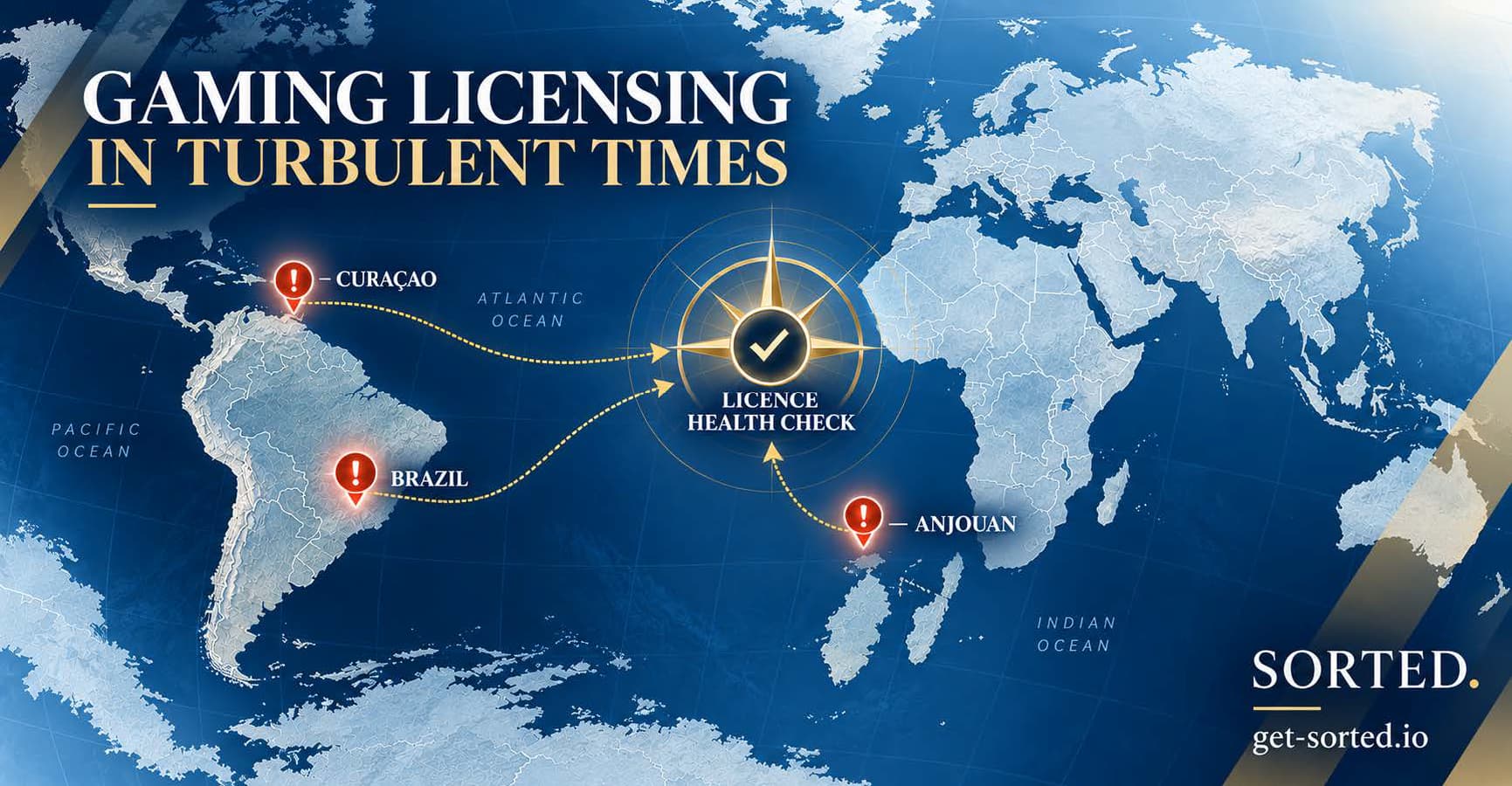
First Curaçao. Then Brazil. Now Anjouan.
In only a few weeks, the international gaming industry has faced three very different disruptions. Each has created new questions for operators, suppliers, investors and service providers.
Curaçao experienced unauthorised access to its online licensing portal, raising serious concerns around data security and the handling of confidential applicant information.
Brazil introduced a measure prohibiting the exploitation, offering, intermediation and advertising of fixed-odds betting across the country, forcing previously authorised operators to prepare for the closure of their operations.
Anjouan is now facing renewed scrutiny following reports questioning the authority, recognition and long-term sustainability of parts of its offshore licensing framework.
These situations are not legally identical. They should not be presented as if they were. They also do not automatically mean that every licence connected to Curaçao or Anjouan is invalid.
However, they point to the same commercial reality:
A gaming licence cannot be treated as a certificate that is obtained once and then forgotten.
A licence forms part of a wider operational structure. That structure must remain legally defensible, commercially acceptable and suitable for the markets in which the business intends to operate.
The question for every operator and supplier is therefore simple:
If the next regulatory, political or technical disruption affected your jurisdiction, would your business be prepared?
Curaçao: when regulatory infrastructure becomes a business risk
Curaçao has played a significant role in international online gaming for many years. Its transition to the National Ordinance on Games of Chance introduced a new framework intended to replace the previous master-licence and sub-licence system with direct regulatory oversight.
That transition already required many businesses to reconsider their corporate arrangements, licence status, compliance responsibilities and relationships with local service providers.
The situation became more complicated when the Curaçao Gaming Authority confirmed that unauthorised access had been identified within its online gaming portal. The authority stated that the access had been contained and that its source had been identified. Nevertheless, the incident raised understandable concerns about the security of information held within a system containing sensitive licensing and applicant data.
For an operator, the concern extends beyond whether its licence remains technically valid.
A significant incident affecting a regulator’s infrastructure can create wider questions:
- What applicant, ownership or financial information may have been accessible?
- Are the company’s registered domains and licence records still correctly reflected?
- Can commercial partners independently verify the current licensing position?
- Will banks, payment providers, platforms or investors request additional evidence?
- Does the company have an alternative plan if the licensing or verification process is interrupted?
An operator may have complied with the applicable licensing requirements and still experience disruption if a bank, PSP, technology provider or investor becomes uncomfortable with the surrounding regulatory environment.
The Curaçao incident therefore illustrates an important distinction: legal validity and commercial usability are connected, but they are not the same thing.
Brazil: a reminder that markets can change faster than business plans
Brazil provides a different example.
In September 2026, the Brazilian government introduced Provisional Measure No. 1,394, prohibiting the exploitation, offering, intermediation and advertising of fixed-odds betting in the country. The measure also provided for the termination of previously granted authorisations and the implementation of procedures governing the closure process.
This is not a technical interruption or an isolated compliance amendment. It represents a fundamental change to the commercial viability of an entire market.
Businesses that invested in licensing, local operations, marketing, technology, personnel and commercial agreements must now evaluate what can be retained, transferred, repurposed or discontinued.
For companies affected by such a development, the immediate questions may include:
- Can the existing corporate and technology infrastructure support entry into other markets?
- Which commercial agreements contain termination or change-of-law provisions?
- Can the business continue serving international markets from its current structure?
- Does it require an additional international licence?
- Are its payment and banking arrangements dependent on Brazilian activity?
- Can the brand, platform and supplier relationships be separated from the discontinued market?
- Which jurisdictions are compatible with the company’s remaining products and target markets?
A licence may have been entirely appropriate when the original investment was made. That does not guarantee that it will continue to support the business when the law, market or political environment changes.
Brazil demonstrates why licensing strategy must be connected to contingency planning. International expansion should not begin only after the primary market has closed.
Anjouan: low cost cannot replace legal and commercial certainty
Anjouan has attracted substantial attention as a lower-cost offshore licensing option. Its accessibility and comparatively straightforward application route have made it attractive to early-stage operators, suppliers and businesses seeking an alternative to increasingly demanding licensing frameworks.
However, recent reporting has raised material questions concerning the authority behind parts of the licensing system and the recognition of licences marketed in Anjouan’s name.
An investigation published by The Guardian reported that the government of the Union of the Comoros disputes the legitimacy of an alleged unauthorised licensing regime and has pursued international cooperation in relation to the matter.
These are serious allegations, but they require careful treatment.
The reports do not provide a simple legal conclusion that every gaming licence connected to Anjouan is automatically invalid. Each operator’s position depends on the issuing route, documentation, corporate structure, date of issuance, responsible service provider, operating model and target markets.
Nevertheless, an operator cannot ignore the questions simply because it possesses a document bearing the word “licence.”
It should be able to demonstrate:
- Which authority issued the licence.
- What legislation or delegated power supports that authority.
- Which company and domains are covered.
- What activities are permitted.
- What ongoing compliance obligations apply.
- How the licence can be independently verified.
- Whether relevant banks, PSPs, game providers and other partners accept it.
- Whether the licence has any standing in the markets where players or business partners are located.
The attraction of a lower application fee can disappear quickly if the operator later discovers that its bank, payment provider, software supplier, investor or acquisition partner will not accept the licensing framework.
The real cost of a licence includes the commercial infrastructure that can operate around it.
A licence can be valid on paper and still fail commercially
Many licensing decisions begin with three questions:
- How much does it cost?
- How long does it take?
- Which documents are required?
Those questions matter, but they are not enough.
A sustainable licensing structure must also work with the company’s products, corporate structure, target markets, banks, PSPs, platforms, game providers and long-term commercial plans.
A licence that looks valid on paper may still create serious problems if key partners will not accept it or if it cannot support the markets the company intends to enter.
The lowest-cost or fastest licence can therefore become an expensive mistake.
Review the licence before a third party does
Operators and suppliers should not wait for a regulator, bank, payment provider, investor or potential buyer to identify weaknesses in their setup.
A review may be appropriate when:
- The licence or registered domains cannot be independently verified.
- The business has entered new markets or added new products.
- The corporate structure no longer reflects the actual operation.
- Commercial partners are requesting additional licensing evidence.
- The company depends heavily on one bank, PSP or platform.
- The business is preparing for investment, acquisition or sale.
- The licence is approaching renewal.
- The original jurisdiction was selected mainly because it was fast or inexpensive.
These points do not automatically mean that the existing structure is defective. They show that it should be checked before the issue affects onboarding, payments, investment or business continuity.
The SORTED. Licence Health Check
SORTED. offers an independent Licence Health Check, starting from €950 plus VAT, for existing operators and B2B suppliers.
Depending on the client’s business model, we assess:
- The current licence and issuing jurisdiction.
- The licensed entity and corporate structure.
- Registered brands, websites and domains.
- Products, services and distribution arrangements.
- Existing and intended target markets.
- Key compliance and operational obligations.
- Banking, payment, platform and supplier dependencies.
- Potential gaps and suitable alternative or additional licensing routes.
The client receives a written summary of our findings and recommended next steps.
The objective is not to persuade every client to replace its licence. In some cases, the review may confirm that the current structure remains suitable. In others, it may identify documentation that should be updated, markets requiring further analysis or risks that should be addressed.
If the client subsequently appoints SORTED. to implement the recommended licensing, restructuring or compliance work, the full Licence Health Check fee is credited against our professional fees.
Choose the business model before the jurisdiction
For a new project, the correct licence cannot be selected until the business model is understood.
Before committing to a jurisdiction, the founders should establish:
- Whether the business will operate as a B2C operator, B2B supplier or both.
- Which products and services it will provide.
- Where its customers and commercial partners will be located.
- Which payment, platform and content providers it intends to use.
- What level of substance and ongoing compliance it can maintain.
- Its launch budget, growth plans and future investment strategy.
Only then can the available jurisdictions be compared properly.
Nevis may provide a strong route for suitable B2B suppliers, B2C operators and qualifying prediction-market models. However, it is not an automatic replacement for Curaçao, Anjouan or any other jurisdiction, and it does not replace national authorisation where one is required.
There is no universally “best” gaming licence. There is only the licence that best fits the particular business, products, target markets and commercial objectives.
Prepare before the next disruption
The developments involving Curaçao, Brazil and Anjouan are different, but they deliver the same warning.
Regulatory frameworks can change. Technology can fail. Governments can reverse policy. Authorities can be challenged. Banks and commercial partners can change their acceptance criteria.
The businesses that remain calm during disruption are normally those that reviewed their dependencies in advance.
They know what their licence covers, where their structure may be vulnerable and which alternative route is available if the current setup stops working.
The goal is not to find the cheapest licence.
The goal is to build the right licensing structure - one that remains credible, commercially workable and sustainable when the market changes again.
To discuss a Licence Health Check or a jurisdiction assessment for a new gaming project, contact SORTED.
Related Articles